
Evo Accessories That Actually Improve the Car
You can tell when an Evo has been “accessorized” versus built.
Accessorized Evos look busy. Built Evos feel tight – cold start to redline, freeway to backroad, first lap to last lap. That difference usually comes down to the parts most people treat as afterthoughts: the supporting pieces around power, cooling, braking, and drivability. The right evo accessories don’t just add a feature. They reduce failure points, sharpen feedback, and keep your setup consistent when the car is hot, loaded, and being driven the way an Evo was meant to be driven.
What “evo accessories” should mean on a real build
In the generic car world, “accessories” means floor mats and phone mounts. In the Evo world, accessories are the supporting parts that make your main mods work the way they’re supposed to.
That includes hard parts that fix weak links (cooling components, boost control hardware, mounts), electronics that keep the car honest (wideband integration, sensors, ECU support), and restoration pieces that bring the platform back to baseline (OEM replacement components that stop leaks, squeaks, and weird drivability issues).
The trade-off is simple: cheap accessories feel like progress until they create a diagnosis problem. A failing sensor, a misrouted vacuum line, or a bracket that doesn’t quite fit can turn a clean tune into a frustrating chase. Evo 7-9 and Evo X owners get punished fast because these cars respond to small changes – and they also expose weak parts quickly.
Start with the build goal, then choose accessories that protect it
If your goal is a clean daily that can handle spirited pulls, you care about heat management, predictable boost, and a drivetrain that doesn’t shock-load itself. If your goal is track days, you care about repeatability: oil temps, coolant temps, brake temps, and suspension consistency. If your goal is big turbo power, you care about signal integrity, fueling control, and eliminating boost leaks you won’t hear over a loud exhaust.
That’s why the best evo accessories are the ones that reduce “variables.” They keep the car operating in a narrow, controllable window.
Cooling and heat management accessories: boring until they save your engine
Evos make heat. Add boost, add timing, add track time, and heat becomes the limiting factor long before “not enough power” does.
A good cooling setup is not one magic part. It’s a system that prevents heat soak and keeps temperatures stable. Radiator efficiency matters, but so do hoses that don’t balloon, caps that hold pressure, thermostats that behave predictably, and fans that actually move air when the car is stationary in the pits.
Here’s the nuance: over-cooling can be a problem in cold climates, especially on a daily-driven Evo X where warmup and fuel trims matter. If you’re in a colder region and the car is mostly street-driven, you want stability more than maximum airflow. If you’re in a hot climate or you’re doing repeated pulls, you want headroom.
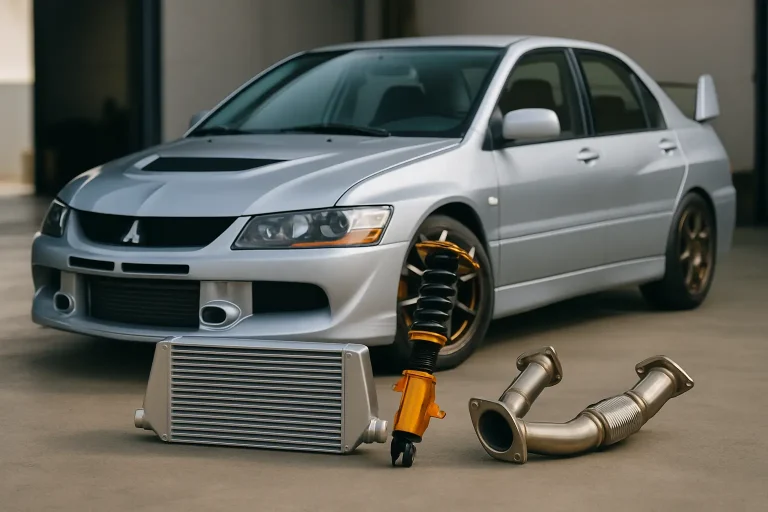
Intercooling is the same story. A big front-mount can be a win, but only if your couplers seal, your clamps hold, and your piping doesn’t rub or pop under load. The “accessories” – quality couplers, proper T-bolt clamps, brackets that don’t flex – are what keep a high-flow intercooler from becoming a boost leak generator.
Intake, boost control, and vacuum hardware: the small stuff that keeps the tune clean
Boost control is one of the fastest ways to make an Evo feel sharp – or unpredictable.
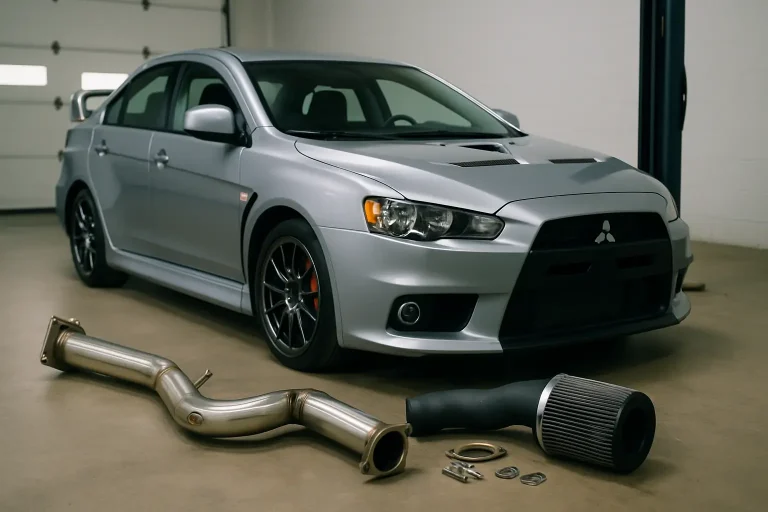
A solid boost control setup depends on a few unglamorous accessories: vacuum line that won’t collapse, routing that makes sense, a boost source that’s stable, and fittings that don’t leak. If you’re running an electronic boost control solenoid, mounting and plumbing matter as much as the brand name. Keep lines short and protected from heat, and avoid routing that creates delay or oscillation.
This is also where “it depends” shows up hard. A street Evo 8/9 on a modest turbo might be perfectly happy with a conservative setup aimed at smooth taper. A track-focused setup may prioritize consistent midrange control and repeatable boost targets lap after lap. Big turbo cars may need tighter control to avoid spikes that knock the motor into timing pull.
If you’ve ever looked at a log and seen boost do something you didn’t command, treat that as a hardware problem until proven otherwise.
Electronics and ECU support: accessories that prevent expensive mistakes
The Evo platform rewards good data. That’s why electronics-focused evo accessories are some of the highest leverage upgrades you can do.
At minimum, you want reliable sensor inputs and a way to monitor what the engine is doing under load. Wideband O2 data, fuel pressure (on higher power builds), and consistent MAP readings are the difference between “it feels fine” and “it is fine.”
The catch is that electronics are only as good as the install. Poor grounds, cheap connectors, and noisy wiring can turn your dashboard into a lie. If you’re stepping up to more advanced ECU control, wiring quality and sensor selection stop being optional.
For Evo X owners especially, electrical stability matters because the car is more integrated from the factory. You’re not just adding a gauge. You’re adding another device into a system that expects clean voltage and predictable signals.
Drivetrain and mount accessories: make power feel usable
Power is easy. Putting it down cleanly is the whole game.
Engine mounts, transmission mounts, and drivetrain bushings are classic Evo accessories because they change the car immediately. The right setup tightens shifting, improves throttle response, and reduces that “rubber band” feeling on/off throttle.
But there’s a real trade-off: NVH. Stiffer mounts can turn your daily into a vibrating gym membership, especially on an Evo 7-9 that already transmits a lot of mechanical feel. Many owners end up happiest with a balanced approach – firm enough to control movement, not so aggressive that the car feels broken at idle.
Clutch-related accessories fall into the same category. Pedal feel, engagement consistency, and hydraulic reliability matter more than bragging rights. If you’re increasing torque, address the components that make launches and shifts repeatable, not just the disc.
Braking accessories: consistency beats peak numbers
Evos can carry speed. That makes brakes a safety system and a performance mod.
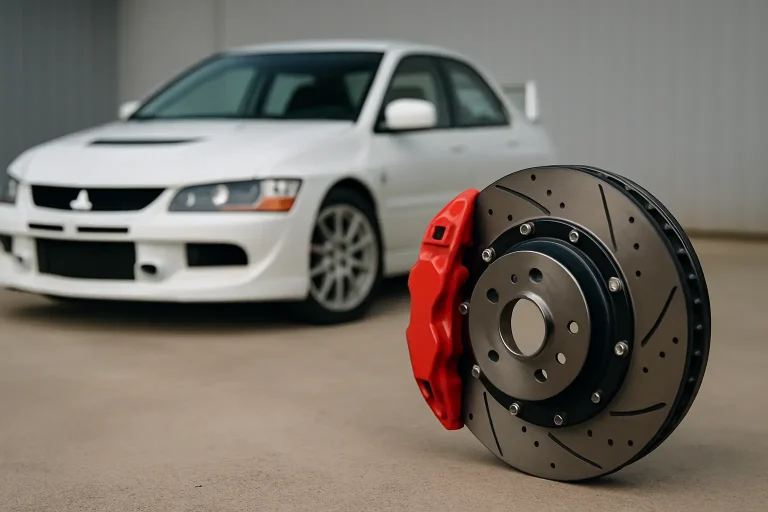
Pads and rotors get the headlines, but the accessories around them are what keep the system consistent. Quality brake fluid, stainless lines (when done correctly), and fresh hardware prevent the soft pedal that ruins a session. Cooling helps too, especially if you’re running sticky tires and doing repeated braking zones.
For street cars, the goal is usually bite without noise and dust that makes you hate the car. For track cars, the goal is predictable torque and fade resistance. Pick accordingly, and remember that the “best” pad on paper can be miserable if it never reaches its ideal temperature range in your use case.
Suspension and steering accessories: the difference between stance and speed
If you want an Evo that feels alive, you need suspension parts that work together.
Alignment, bushings, ball joints, end links, and arms don’t get the glory of coilovers, but they decide whether your coilovers can do their job. Worn bushings make the car vague. Sloppy joints make alignment settings meaningless. Upgraded arms and links can be the only way to get the geometry you need after lowering or changing wheel/tire setup.
This is where platform specificity matters. Evo 7-9 and Evo X have different factory baselines, different common wear points, and different packaging constraints. Fitment accuracy isn’t a nice-to-have – it’s the difference between “bolts in” and “fights you for six hours.”
How to pick evo accessories without wasting money
Good selection is less about hype and more about asking a few direct questions.
First: what problem is this part solving? “Because it’s popular” is not a problem statement. “My coolant temps climb after two pulls” is.
Second: what does failure look like? If a part fails, does it just annoy you, or can it take the engine with it? That’s why clamps, hoses, sensors, and fueling-related components deserve more respect than they get.
Third: is it designed for your exact generation? The Evo community loves cross-platform ideas, but Evo 8 fitment assumptions can burn Evo X owners quickly, and vice versa.
Fourth: what else has to change for this to work? A bigger turbo might require different boost control hardware, different intercooler piping, a different intake solution, and the monitoring to keep it safe. Accessories are rarely “extra.” They’re often the missing prerequisites.
If you’re building with reliability in mind and you want parts that are selected by people who actually live with these cars, Evo Motor Parts focuses exclusively on Evo 7-9 and Evo X fitment and build paths, which is exactly where most of the guesswork gets eliminated.
The real win: accessories that make the car easier to trust
The best part about choosing the right accessories is that you stop driving the car like it might do something weird. You stop listening for the coupler that might blow off, watching the temp needle climb in traffic, or wondering if that stumble is “normal.”
Build the Evo so the supporting parts are as serious as the headline mods, and the whole car changes character. Not louder, not flashier – just more confident, every time you roll into boost.